
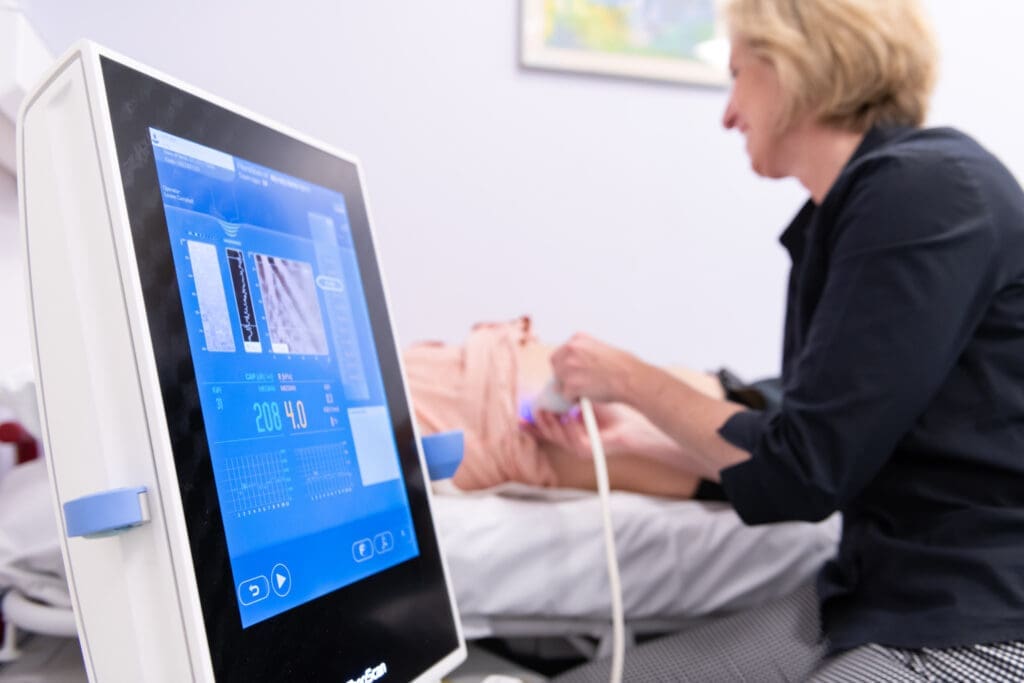
FibroScan services help NHS Trusts and Integrated Care Boards (ICBs) assess liver fibrosis risk earlier in the patient pathway. By providing non-invasive liver stiffness measurements in community or hospital settings, FibroScan enables effective triage, reduces avoidable specialist referrals, and accelerates patient pathways to appropriate care.
Liver disease places increasing pressure on NHS services, yet many patients remain undiagnosed until their condition has already progressed significantly. For NHS Trusts, ICBs, and diagnostic teams, the challenge involves identifying more patients at risk while creating a clear, operational pathway that can assess, triage, and manage those patients efficiently.
FibroScan services can play an essential role in that pathway. By delivering non-invasive liver stiffness assessment in hospital, community, or Community Diagnostic Centre (CDC) settings, FibroScan helps NHS teams identify patients at higher risk of fibrosis. This diagnostic data supports primary care decision-making, improves referral accuracy, and helps reduce avoidable pressure on specialist clinics.
Liver disease is often asymptomatic until the later stages, making early detection a significant clinical and operational challenge. Risk factors are rising rapidly, closely linked to metabolic health, type 2 diabetes, obesity, alcohol-related liver disease, and viral hepatitis. Specifically, metabolic dysfunction-associated steatotic liver disease (MASLD) and non-alcoholic fatty liver disease (NAFLD) share close ties with obesity and cardiovascular disease, broadening the volume of patients requiring assessment.
Early detection matters because clinicians can manage fibrosis and cirrhosis risk much more effectively when identified sooner. However, the current pressure is not purely clinical. It is deeply operational. The British Liver Trust reported in January 2025 that 80% of regional health bodies in England lacked an effective pathway to diagnose and manage liver disease. Without consistent pathways for abnormal liver blood tests and fibrosis assessment, patients can be referred unnecessarily, reviewed too late, or moved through services inconsistently.
FibroScan should be utilised as a risk stratification tool within a broader liver pathway, rather than a standalone scan. Typically, patients undergo initial risk assessments using liver blood tests, FIB-4 scoring, or Enhanced Liver Fibrosis (ELF) testing. Depending on local pathway design and primary care triage, FibroScan provides the vital next step.
FibroScan supports NHS pathways by delivering non-invasive fibrosis assessment and liver stiffness measurement. This allows clinical teams to identify patients at higher risk much earlier in their journey. Furthermore, it enables accurate referral triage into hepatology or gastroenterology, supports the monitoring of known higher-risk groups, and reduces unnecessary specialist appointments for lower-risk patients.
NICE guidelines acknowledge the role of transient elastography (FibroScan) in assessing liver fibrosis and cirrhosis. NICE recommends its use for ongoing monitoring in people with alcohol-related liver disease, hepatitis C without sustained virological response, hepatitis B, and NAFLD with advanced fibrosis.
Many liver pathway issues start well before secondary care. Patients often present to their GP with abnormal liver blood tests or distinct risk factors. Without accessible assessment routes, primary care clinicians must either refer these patients into specialist services too early or risk missing disease progression until a later date.
FibroScan services address this gap by supporting GP referral pathways and community liver health checks. Delivering CDC-based liver fibrosis assessment allows systems to establish risk-based triage for MASLD/NAFLD and alcohol-related liver disease, directly reducing variation in access to diagnostics.
There are already successful examples of FibroScan services operating within community diagnostic settings. According to North Central London ICB, the Wood Green CDC liver disease detection service effectively evaluates adults who meet fatty liver primary care pathway criteria requiring assessment for liver fibrosis or cirrhosis.
For hepatology and gastroenterology teams, outpatient capacity is a highly valuable resource. FibroScan helps improve the quality of referrals by clearly identifying which patients genuinely require specialist review.
Implementing FibroScan at the triage stage ensures fewer low-risk referrals enter specialist clinics unnecessarily. It establishes a clearer escalation route for patients with higher fibrosis risk, ensuring consultant and specialist nurse capacity is directed toward those with the highest clinical need. Furthermore, it offers a reliable method for supporting long-term surveillance pathways.
Used properly, FibroScan is a strategic pathway tool that helps NHS teams direct specialist resources towards the patients most likely to need them, thereby reducing diagnostic imaging waiting lists and accelerating patient pathways.
NHS England describes CDCs as facilities providing additional diagnostic capacity in community settings, helping patients access co-ordinated testing in as few visits as possible. CDCs are designed specifically to increase diagnostic capacity away from acute hospital environments.
FibroScan fits perfectly within community diagnostic models because the procedure is non-invasive, highly accessible, and pathway-friendly. Providing these scans in the community reduces footfall in acute hospital outpatient departments while making the assessment far more convenient for patients. For integrated care systems developing community liver services, FibroScan provides a highly practical diagnostic component within a broader liver risk assessment pathway.
When NHS diagnostic, procurement, or transformation leads plan a new FibroScan service, several operational elements require careful definition. Use the following checklist to ensure a smooth implementation:
External diagnostic partners can provide immediate, flexible capacity when internal NHS resources are stretched. Choose an external FibroScan service provider if your organisation needs to:
RMS helps NHS Trusts increase diagnostic capacity, reduce waiting lists, and improve patient pathways through flexible staffing, scanning hardware, and fully managed diagnostic solutions. As a trusted NHS delivery partner, RMS supports organisations with diagnostic service delivery designed entirely around local pathway needs.
For liver services, this includes FibroScan provision to help assess fibrosis risk, support referral triage, and improve access to non-invasive liver assessment in hospital, community, or diagnostic centre settings. RMS helps NHS teams add practical diagnostic capacity around the exact pathway they already need to deliver, maximising existing resources and relieving pressure on overstretched staff.
FibroScan services play an important role in NHS liver pathway support, particularly where local health systems are looking to improve early detection, strengthen referral triage, and reduce avoidable pressure on specialist clinics. When embedded into a clear, well-managed pathway, FibroScan gives NHS teams a practical, non-invasive way to assess fibrosis risk and help patients access the right level of care sooner.
Planning or expanding an NHS liver pathway? RMS can support FibroScan service delivery across hospital, community and diagnostic settings, helping NHS teams improve access to liver fibrosis assessment and strengthen pathway capacity. Contact our team today to discuss flexible diagnostic support tailored to your local service model.
Community FibroScan services are best suited for adult patients identified in primary care with abnormal liver blood tests or specific risk factors for liver disease, such as type 2 diabetes, obesity, or high alcohol intake. It acts as a triage tool for patients who require fibrosis risk stratification before a specialist hepatology referral is made.
Costs vary depending on the specific requirements of the NHS Trust, including the required weekly scan volume, staffing needs, and whether the service is delivered in a hospital or community setting. Fully managed services provide predictable, cost-effective pricing structures that include equipment, trained operators, and patient booking management.
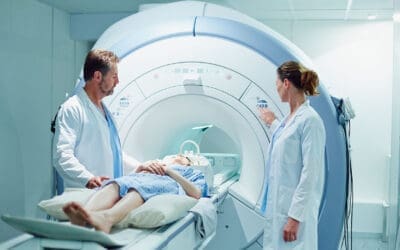
Because FibroScan equipment is highly portable and requires minimal structural setup compared to MRI or CT scanners, an outsourced service can often be deployed within a matter of weeks. The exact timeline depends on local governance approvals, pathway mapping, and IT integration for reporting results.
Alternatives include serum biomarkers (such as the Enhanced Liver Fibrosis or ELF test) and clinical scoring systems (like the FIB-4 index). While blood tests and scoring systems are excellent first-line triage tools, FibroScan provides a direct physical measurement of liver stiffness. A liver biopsy is the definitive diagnostic alternative, but it is highly invasive, costly, and carries higher clinical risks.
FibroScan is entirely non-invasive and carries no physical risk to the patient. However, there are clinical limitations. Severe obesity or narrow intercostal spaces can occasionally make it difficult to obtain accurate readings. In such cases, alternative imaging modalities or specialist clinical review may be required.